How Digital Marketing Helps Businesses Increase Leads and Sales
Let me paint a picture.
Two bakeries open in the same city, same month. Same quality products. Similar pricing. One owner spends her weekends posting on Instagram, running Google ads, and replying to every review online. The other puts up a signboard and waits.
Twelve months later, one has a waitlist. The other wonders where the customers went. The difference was not the bread. It was visibility. And visibility in 2026 comes from digital marketing.
This is not a story about big budgets or complex strategies. It is about understanding that the way people find, trust, and buy from brands has fundamentally changed. And the businesses that understand this are the ones growing.
What Digital Marketing Actually Does For Your Revenue
People often think of digital marketing as posting on social media or running a few ads. That is only the surface.
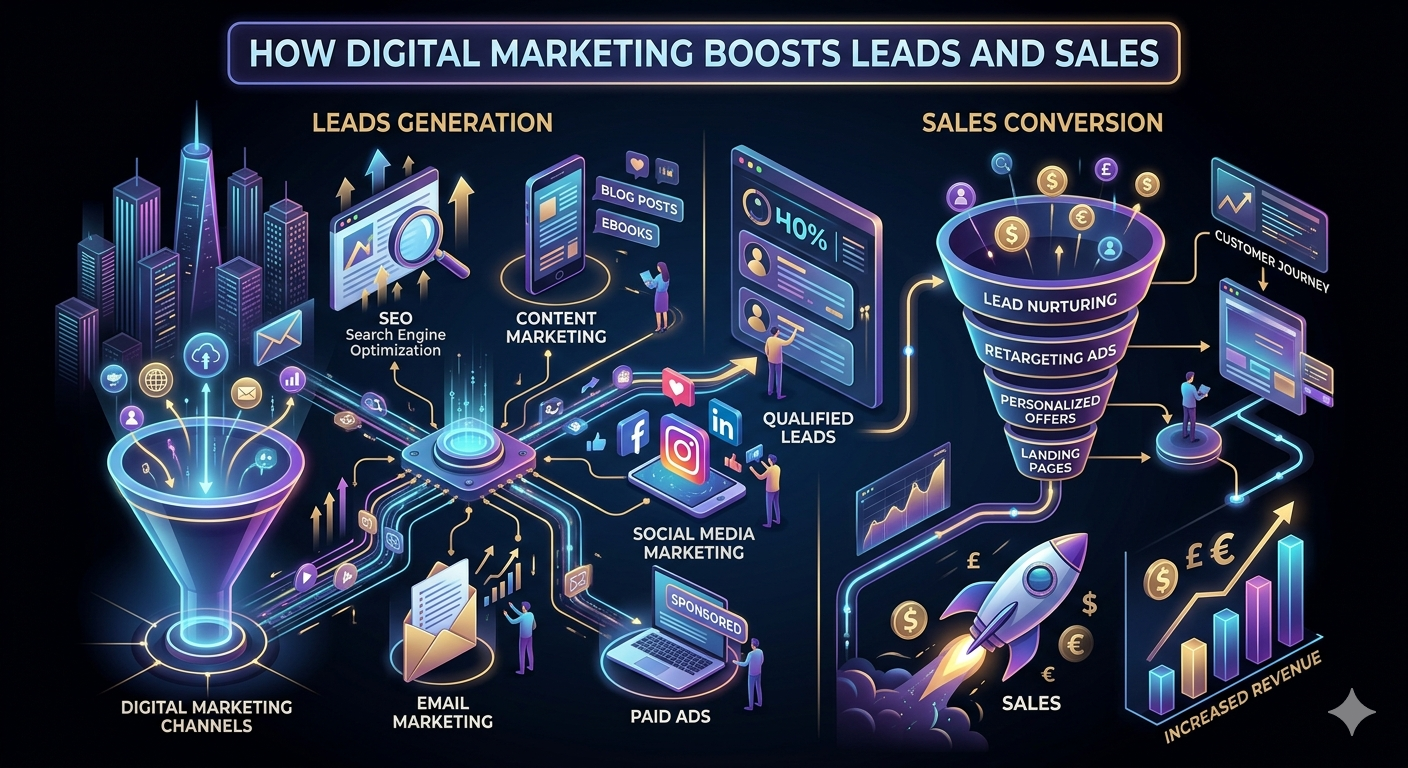
At its core, digital marketing is a system. It attracts the right people, builds enough trust for them to consider you, and then converts that interest into a sale. Done consistently, it does this around the clock without you being in the room.
According to HubSpot's 2024 State of Marketing Report, businesses that use a documented digital marketing strategy are 313% more likely to report success than those that do not. Not slightly more likely. Three times more likely.
That gap between having a plan and not having one is where most leads and sales are either captured or lost.
The Numbers Behind Why It Works
Before diving into the how, it helps to understand the scale of the opportunity.
According toStatista global digital advertising spending reached $740 billion in 2024 and is projected to cross $870 billion by 2026. Brands are not pouring money into digital because it looks good on a strategy deck. They are doing it because it delivers measurable results.
According toGoogle, businesses make an average of $2 in revenue for every $1 spent on Google Ads. That is a return most traditional advertising channels cannot touch.
And organic search is not far behind. BrightEdge reports that organic search drives 53% of all website traffic, making SEO one of the highest-return, lowest-cost channels available to any brand regardless of size.
The opportunity is real. The question is how to use it well.
How Digital Marketing Generates Leads
Lead generation used to mean cold calls, trade shows, and print ads. All of that still exists. But digital marketing changed the game by making it possible to reach people who are already looking for what you offer.
Here is how the main channels contribute:
| Digital Marketing Channel | How It Generates Leads | Average ROI |
|---|---|---|
| Search Engine Optimisation (SEO) | Brings organic traffic from people actively searching for your products or services. | 748% average ROI (Terakeet, 2023) |
| Google Ads / PPC | Puts your brand in front of high-intent searchers and drives immediate traffic. | $2 return per $1 spent (Google) |
| Email Marketing | Nurtures warm leads and converts prospects into paying customers. | $36 return per $1 spent (Litmus, 2024) |
| Social Media Marketing | Builds brand awareness, engagement, and drives traffic to your offers. | 73% of marketers report positive results (Sprout Social, 2024) |
| Content Marketing | Attracts leads through valuable, searchable, and educational content. | 3x more leads than outbound marketing at 62% lower cost (Demand Metric) |
| Video Marketing | Educates audiences, showcases products, and improves conversion rates. | 87% of marketers say video increased sales (Wyzowl, 2024) |
None of these work in isolation. The businesses seeing the strongest results are combining two or three channels into a connected system where each one supports the others.
SEO: The Lead Generation Channel That Keeps Working
If you only ever invested in one digital marketing channel, SEO would make the strongest case.
Here is why. Every other channel stops the moment you stop paying. Ads go dark when the budget runs out. Email campaigns need someone to keep sending them. But a well-optimised piece of content keeps attracting visitors for months, sometimes years, after it was published.
According to Ahrefs, 90.63% of pages on the internet get zero traffic from Google. That sounds discouraging. But it also means that the businesses willing to do the work of optimising their content have enormous room to stand out.
A real example. A small accounting firm in Hyderabad published twelve blog posts answering common tax questions their clients kept asking. Within eight months, those posts were bringing in over 3,000 monthly visitors from search alone. No ads. No social media push. Just useful content that people were already searching for.
That is what SEO does at its best.
Email Marketing: The Most Underrated Sales Tool Online
Everyone gets too many emails. That is true. And yet email marketing consistently delivers the highest return on investment of any digital channel.
According to Litmus's 2024 Email Marketing Report, every rupee or dollar spent on email marketing returns an average of 36 times that amount. No other channel comes close to that ratio.
The reason is simple. Email reaches people who already raised their hand. They signed up. They gave you permission. That level of intent is far higher than someone who just stumbled across an ad.
For lead nurturing specifically, email is irreplaceable. A potential customer might visit your website, find it interesting, and then forget about you entirely. An email sequence keeps you in their mind. It answers their questions over time. It builds the kind of familiarity that eventually turns into a sale.
Social Media: Where Trust Gets Built Before the Sale
Social media rarely closes the deal directly. But it does something arguably more important. It builds the trust that makes the deal possible.
According to Sprout Social's 2024 Index, 68% of consumers follow brands on social media to stay informed about products and services, and 46% say that a brand's social media presence influences their purchase decision.
Think about how you behave as a buyer. Before you book a restaurant, hire a freelancer, or buy from a new brand online, you probably check their Instagram or LinkedIn first. You are looking for signs of life. Recent posts. Real engagement. A personality.
That is the job social media does. It is the equivalent of a shopfront that people walk past every day. The more consistently it shows up, the more familiar and trustworthy your brand becomes.
Content Marketing: The Long Game That Pays Off
Content marketing is not about going viral. It is about being useful.
When your brand consistently publishes content that answers the questions your audience is already asking, something happens over time. You stop being just another option. You become the go-to resource. And go-to resources do not have to compete on price.
According to Demand Metric, content marketing generates three times more leads than outbound marketing and costs 62% less. For brands that are not working with large ad budgets, content is often the most powerful equaliser available.
A fitness equipment brand that started a YouTube channel answering common workout questions grew from 800 monthly website visitors to over 40,000 in eighteen months. No paid ads. Just consistent, useful content that built an audience organically.
Paid Advertising: The Accelerator When You Need Speed
Everything above takes time. Paid advertising is what you use when you need results faster.
Google Ads, Meta Ads, and LinkedIn Ads all allow you to put your brand directly in front of people based on what they are searching for, what they are interested in, and what stage of the buying journey they are in.
According to WordStream's 2024 Google Ads Benchmarks, the average conversion rate across industries on Google Ads is 4.40% on the search network. For high-intent searches, that number climbs significantly.
The key with paid advertising is targeting. Broad, untargeted ads waste money. Specific, well-researched ads aimed at the right audience at the right moment deliver measurable returns.
A Real Brand That Got This Right
Nykaa is one of India's clearest examples of digital marketing done well.
Starting as a purely online beauty retailer, Nykaa built its customer base almost entirely through digital channels. Content marketing through beauty tutorials and expert guides. SEO that made them the first result for hundreds of product searches. Email campaigns with personalised recommendations. Social media that built a community of loyal followers.
By 2024, Nykaa had over 35 million registered users. They did not outspend competitors. They out-marketed them digitally.
What Happens When Businesses Ignore Digital Marketing
The cost of inaction is not zero. It is losing ground to competitors who are showing up where you are not.
According to a 2024 report by Salesforce, 88% of customers say the experience a brand provides is as important as its products. That experience begins online, long before anyone speaks to your team.
Businesses that are not investing in digital marketing are not just missing leads. They are slowly becoming invisible to the very customers who would have chosen them.
