Why Every Business Needs a Strong Digital Presence in 2026
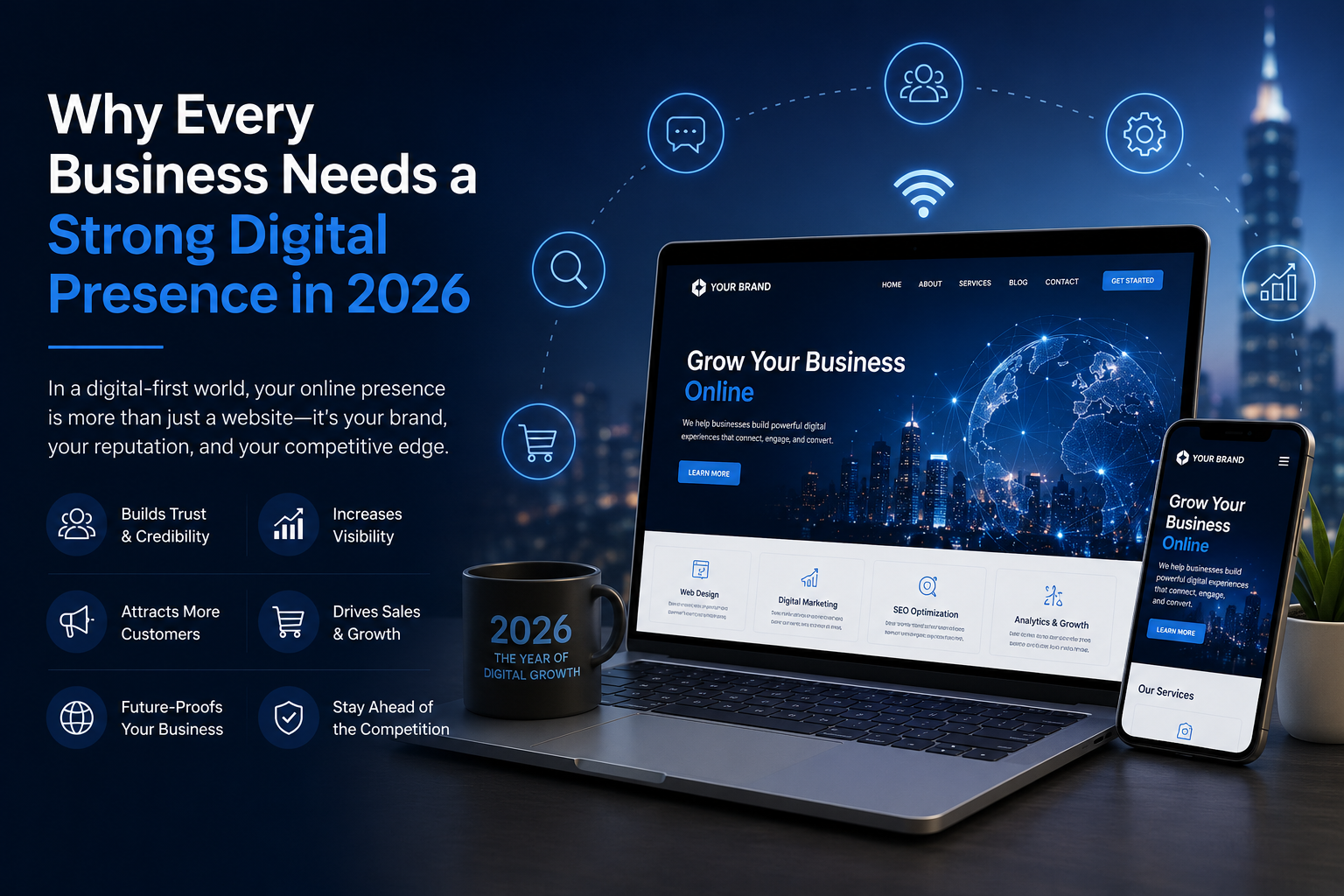
Let me ask you something simple. When was the last time you looked up a business before visiting it? Before calling them? Before trusting them with your money?
Probably today.
That is exactly what your customers are doing to you right now. They are searching, scrolling, comparing, reading reviews, and forming opinions about your business before you even know they exist.And if they cannot find you online, or worse, if what they find looks outdated and unimpressive, you have already lost them.
In 2026, digital presence is not a checkbox item. It is the foundation of how businesses survive, grow, and compete.
What Digital Presence Actually Means in 2026
A lot of business owners think digital presence means having a website and maybe a Facebook page. That was 2015.
Today, it means something much bigger.
It means being visible where your customers are searching. It means delivering experiences that feel personal and seamless, whether someone finds you on Google, Instagram, a mobile app, or a voice search. It means your brand feels alive and trustworthy at every digital touchpoint.
Here is what a strong digital presence looks like in 2026:
| Component | What It Does For Your Business |
|---|---|
| Professional website | Your 24/7 storefront and first impression |
| Search engine visibility | Brings customers to you without paid ads |
| Social media presence | Builds community and brand personality |
| Mobile application | Convenient access and higher retention |
| E-commerce capability | Lets customers buy anytime, anywhere |
| AI-powered interactions | Personalised experiences at scale |
| Consistent branding | Builds recognition and trust over time |
| Online reviews | Influences purchase decisions |
Every single one of these works together. Remove one and the whole system weakens.
Your customers do the same.
According to BrightEdge 53.3% of all website traffic comes from organic search. More than half. That means if your business is not showing up in search results, you are invisible to more than half the people looking for what you offer.
According to Statista, there were over 5.45 billion internet users worldwide in 2025, representing nearly 67% of the global population. That number keeps climbing. The audience is there. The question is whether your business can be found by them.
And it is not just about being found. According to Google, 76% of people who search for something nearby on their smartphone visit a related business within 24 hours. That is foot traffic driven directly by digital visibility.
Your Customers Start Online. Every Single Time.
And it is not just about being found. According to Google, 76% of people who search for something nearby on their smartphone visit a related business within 24 hours. That is foot traffic driven directly by digital visibility.
Your Website Is Your Most Valuable Business Asset. Treat It That Way.
Here is a hard truth. Many businesses spent good money building a website three or four years ago and have not touched it since. No updates. No redesign. No fresh content.
Ask yourself honestly:
When was the last time your website was updated? Is it mobile-friendly? Does it load in under three seconds? Does it reflect who your business is today?
If the answers make you uncomfortable, that is a signal worth paying attention to.
According to Google, 53% of mobile users abandon a site that takes longer than three seconds to load. Three seconds. That is all the patience your customer has before they leave and go to your competitor.
And it goes beyond speed. A study by Stanford University found that 75% of users judge a company's credibility based on its website design alone. Not the product. Not the reviews. The website design.
Your website is not just a digital address. It is your most powerful sales tool, your brand's first impression, and your customer's first reason to trust you or walk away.
Digital Presence Is Not a One-Time Project
This is where a lot of businesses go wrong. They launch a website, set up social media accounts, and then treat it as done. It is never done.
The businesses winning online are the ones consistently showing up. They publish useful content. They update their pages. They respond to comments and reviews. They run campaigns. They track what is working and adjust.
According to HubSpot's 2024 State of Marketing Report, companies that publish blog content regularly generate 3.5 times more traffic and 4.5 times more leads than companies that do not.
Consistency is not glamorous. But it is what builds trust over time.
AI and Personalisation Are No Longer Optional
Customer expectations have shifted significantly.
People no longer want to feel like they are browsing a generic catalogue. They want to feel like the experience was made for them. Personalised product recommendations. Instant responses. Smart support that knows their history.
According to McKinsey, companies that excel at personalisation generate 40% more revenue from those activities than average players.
And the technology to deliver this is now accessible to businesses of all sizes. AI-powered chatbots, recommendation engines, dynamic email content, and smart ad targeting are not just for enterprise companies anymore.
The businesses that embrace these tools will be able to engage more customers, convert more leads, and build stronger loyalty than those still operating on one-size-fits-all digital strategies.
Trust Is Built Online Before It Is Earned In Person
Here is something most business owners underestimate.
By the time a customer contacts you, they have already decided whether they trust you. That decision was made online.
Your digital presence is your reputation. A modern website, consistent brand voice, helpful content, positive reviews, and active social channels all add up to a single message: this business is credible and worth my time.
Neglect any one of these and that message starts to fall apart.
Real World Proof: What Digital-First Looks Like
Revolut is one of the clearest examples of what happens when a business commits fully to its digital presence.
After receiving its UK banking license in 2026, Revolut became the largest digital bank in Europe. No physical branches driving that growth. Just a seamless mobile experience, strong digital branding, continuous product innovation, and an obsession with the customer journey online.
They scaled globally because their digital presence was built to scale.
Closer to ground level, small businesses tell the same story in smaller numbers. A bakery in Pune that started posting consistently on Instagram and optimised their Google Business profile saw a 60% increase in weekend walk-ins within six months. Not because they changed their products. Because they became visible.
Building a Digital Presence That Can Compete in 2026
- Website development that is fast, mobile-first, and designed to convert visitors into customers.
- Search engine optimization so the right people find you at the right moment.
- Social media strategy that builds community and keeps your brand top of mind.
- Mobile experience because web traffic globally now comes from mobile devices.
- E-commerce capability so customers can buy from you whenever they are ready, not just when your shop is open.
- Brand consistency across every platform, so your business looks and feels the same whether someone finds you on Google, Instagram, or LinkedIn.
- AI-powered tools to personalise experiences and respond faster than any manual process can.
Here is what the businesses growing fastest are investing in right now:
The Real Question Is Not Whether You Need Digital Presence
It is whether yours is strong enough.
Because your competitors are online. Your customers are online. The search results, the reviews, the social feeds, the ads, they are all happening whether you participate or not.
Businesses that invest in digital presence are not just staying visible. They are building something that compounds over time. Every article published, every review responded to, every page optimised adds to a foundation that keeps working even when you are not.
The businesses that will struggle in the next few years are not the ones without good products or services. They are the ones that stayed digitally invisible while their competitors showed up every single day.
Now is the time to show up.
